India’s packaged foods and dairy space is about to welcome its most closely watched public market debut of the year. The Milky Mist IPO opened for subscription on August 11, 2026, and by the time most investors read this, it will already be live — closing on August 13, 2026, with shares tentatively set to list on the NSE and BSE on August 18, 2026. For a company that built one of South India’s most recognisable dairy brands almost entirely through private capital and founder-led grit, going public marks a genuine inflection point.
This article breaks down everything worth knowing about the Milky Mist IPO — the company, the numbers, the risks, and the valuation debate currently playing out among analysts — and then looks at the bigger picture: how investors can get exposure to the next Milky Mist long before it ever files a DRHP, through the unlisted shares market and platforms like Heed Unlisted.
About Milky Mist: From Erode Dairy to National Packaged-Food Player
Milky Mist was founded in 1985 by T. Sathish Kumar and has grown from a regional Tamil Nadu dairy operation into one of India’s leading value-added dairy and packaged food companies. Headquartered in Erode, Tamil Nadu, the company has built what it describes as farm-to-retail infrastructure — sourcing milk directly from a network of over 67,600 farmers across South India, largely bypassing traditional intermediaries to maintain quality and cost control across its supply chain.
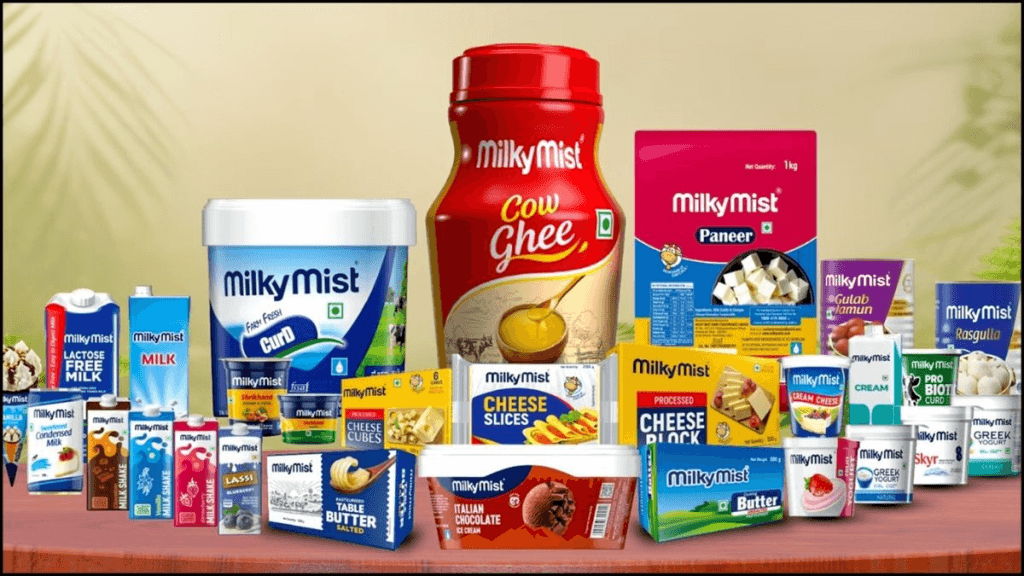
The company’s core strength lies in value-added dairy products rather than commodity milk. Milky Mist holds an estimated 17% market share in India’s private packaged paneer segment and ranks third nationally in the cheese category — both product lines that have benefited from rising urban consumption of convenience dairy foods. Beyond paneer and cheese, the company’s portfolio spans butter, curd, ghee, yogurt, ice cream, UHT (ultra-high temperature) products, frozen foods, ready-to-eat and ready-to-cook meals, and chocolates, sold under the flagship Milky Mist brand alongside sub-brands including SmartChef, Capella, Misty Lite, Briyas, and Asal.
Distribution is where Milky Mist’s scale becomes most apparent: the company reaches more than 350,000 retail touchpoints across 22 states through a network of 3,062 distributors, backed by its own logistics infrastructure — including a growing footprint of visi coolers, ice cream freezers, and chocolate coolers placed directly at retail points to preserve product quality. Notably, Milky Mist counts Temasek, the Singapore state investment firm, among its backers, lending institutional credibility to the IPO ahead of listing.
Milky Mist IPO: Key Details at a Glance
| Detail | Information |
|---|---|
| IPO Open Date | August 11, 2026 |
| IPO Close Date | August 13, 2026 |
| Price Band | ₹133 – ₹140 per share |
| Face Value | ₹2 per share |
| Lot Size | 107 shares |
| Minimum Investment (Retail) | ₹14,980 (at upper price band) |
| Total Issue Size | ₹1,553 crore |
| Fresh Issue | ₹1,428 crore |
| Offer for Sale (OFS) | ₹125 crore |
| Listing Exchanges | NSE and BSE |
| Tentative Allotment Date | August 14, 2026 |
| Tentative Listing Date | August 18, 2026 |
| Book Running Lead Managers | JM Financial, Axis Capital, IIFL Capital Services |
| Registrar | KFin Technologies Limited |
| Retail Quota | 35% |
| QIB Quota | 50% |
| HNI/NII Quota | 15% |
Interestingly, the size of the offer has changed since the company first approached the market. Milky Mist filed its Draft Red Herring Prospectus (DRHP) with SEBI on July 21, 2025, originally targeting a considerably larger raise — reports at the time pointed to an overall issue size around ₹2,035 crore, comprising a fresh issue of roughly ₹1,785 crore and an OFS of about ₹250 crore. By the time the final Red Herring Prospectus was filed and the price band announced, the offer had been resized down to the current ₹1,553 crore structure. This kind of downward revision between DRHP and RHP isn’t unusual — it typically reflects shifting market conditions, revised capital requirements, or promoter and investor decisions on how much stock to offload at listing — but it’s a useful reminder that headline IPO numbers can move meaningfully between the initial filing and the actual subscription window.
Financial Performance: Fast Growth, But Not Without Questions
Milky Mist’s financial trajectory is the central pillar of the bull case. As per its DRHP disclosures, the company’s revenue grew at a compound annual growth rate (CAGR) of nearly 29.82% between FY2023 and FY2025, crossing ₹15,000 million (₹1,500 crore) in that period. That growth accelerated further into FY26: the company reported revenue of ₹3,145.01 crore for the year ended March 2026, up sharply from ₹2,354.79 crore in FY25 — a year-on-year increase of roughly 34%.
Profitability has moved even faster. Profit after tax jumped 176% year-on-year to ₹127.01 crore in FY26, up from ₹46.07 crore in FY25. FY25 EBITDA was reported at approximately ₹310 crore, translating to an EBITDA margin of around 13.2% — a reasonably healthy figure for a branded food manufacturer operating at scale.
However, a closer look at the FY26 profit number reveals some nuance worth flagging for prospective investors. Roughly 19% of that 176% profit jump came from a prior-year tax credit rather than core operating improvement; stripping that out, underlying profit growth was closer to 122%. Separately, an interest subsidy reportedly reduced gross interest expense by around 20% — a genuine financial benefit, but again not a reflection of operational efficiency gains. Some reports have also flagged inventory reporting discrepancies versus figures shared with lending banks, along with auditor commentary noting that internal-audit coverage needed improvement during FY26 — details serious investors will want to review directly in the RHP before applying.
How Milky Mist Plans to Use the IPO Proceeds
Per the DRHP, the bulk of fresh issue proceeds are earmarked for financial de-risking rather than pure growth capital, which is a meaningful signal about the company’s current balance sheet position:
- Repayment or prepayment of borrowings: ₹750 crore (approximately 42% of proceeds) — by far the largest single use, aimed at reducing Milky Mist’s debt load and, in turn, its interest burden going forward.
- Capital expenditure for the Perundurai Manufacturing Facility: ₹414.71 crore (about 23%), funding expansion and modernisation of the company’s core production facility in Tamil Nadu.
- Deployment of visi coolers, ice cream freezers, and chocolate coolers: ₹129.42 crore (about 7%), supporting retail-level cold chain infrastructure that’s central to Milky Mist’s distribution strategy.
- General corporate purposes: the remaining balance, for working capital and other operational needs.
The heavy weighting toward debt repayment underscores a broader theme in the IPO: this listing is, in large part, a de-leveraging exercise. Analysts have noted that the shift from a debt-heavy balance sheet to a lower-debt or potentially net-cash position post-IPO could be one of the primary drivers of shareholder value going forward, assuming the company’s operating performance holds up.
Strengths Driving Investor Interest
Several factors have made Milky Mist one of the more anticipated consumer-sector IPOs of 2026:
- Strong brand presence across categories. Rather than being a single-product dairy company, Milky Mist has built a diversified portfolio spanning paneer, cheese, ice cream, and packaged snacks — reducing dependence on any single product line.
- Category leadership. A 17% share in private packaged paneer and a third-place national ranking in cheese are meaningful positions in categories with structurally rising demand as Indian consumers shift toward branded, packaged dairy over loose, unbranded alternatives.
- Vertically integrated sourcing. Direct procurement from over 67,000 farmers gives Milky Mist tighter control over input quality and cost compared to competitors relying more heavily on intermediaries.
- Automated, modern manufacturing. The company’s manufacturing facilities use automated production processes, supporting consistency and scale as volumes grow.
- Extensive, proprietary distribution. Reaching 350,000+ retail touchpoints through a dedicated distributor and cold-chain network is a genuine moat that’s expensive and time-consuming for competitors to replicate.
- Marquee institutional backing. Temasek’s involvement as an investor adds a layer of due-diligence credibility that many first-time IPO issuers lack.
Key Risks to Weigh Before Applying
No IPO analysis is complete without an honest look at the downside case, and Milky Mist has several risk factors worth taking seriously:
- Heavy geographic concentration. More than 97% of Milky Mist’s raw milk supply comes from Tamil Nadu alone, and 71–78% of total revenue is concentrated in South Indian markets. Any regional disruption — weather-related supply shocks, state-level regulatory changes, or a localized demand slowdown — could disproportionately affect the business.
- Single-facility manufacturing risk. Core production is concentrated at the Perundurai facility in Tamil Nadu. Operational disruptions at this single site — whether from equipment failure, regulatory action, or other causes — pose a concentrated risk that more geographically diversified peers don’t face to the same degree.
- Regulatory and statutory dependency. As a food manufacturer, Milky Mist’s operations depend on maintaining various statutory approvals and licenses; any compliance lapses or regulatory tightening could affect operations.
- Product quality and safety exposure. Dairy products carry inherent risks around contamination, spoilage, and storage failures — issues that can cause significant reputational and financial damage if they occur, given the perishable nature of the product category.
- Legal proceedings. The company has disclosed exposure to legal proceedings involving the company itself, its promoters, and key management personnel — details investors should review in the RHP’s legal disclosures section before applying.
- High leverage and negative free cash flow historically, which is part of why debt repayment dominates the use-of-proceeds breakdown — a signal that the balance sheet has been under some strain ahead of listing.
- Reporting and audit process gaps, including flagged inventory discrepancies versus bank-reported figures and auditor commentary on internal-audit coverage, both worth independently reviewing rather than glossing over.
Valuation: Is Milky Mist Priced for Perfection?
This is where the Milky Mist IPO becomes genuinely debatable. At the upper end of the price band (₹140 per share), the IPO values the company at approximately ₹10,778 crore — roughly 85 times FY26 reported earnings, and closer to 105 times earnings once the one-off tax credit benefit is excluded. By most conventional valuation yardsticks, that’s a steep multiple, even for a fast-growing branded consumer company.
The comparison analysts are watching most closely is against Hatsun Agro Product, a larger, more established listed dairy peer. Whether Milky Mist is priced at a discount or premium to Hatsun on a like-for-like basis will meaningfully influence whether the stock has room for listing-day gains or whether the IPO has already priced in most of the near-term growth story. As one industry analysis put it, buyers at this valuation are effectively paying up front for Milky Mist’s transition from a leveraged regional dairy business into a national, profitable packaged-food company — a transition that is underway but not yet fully complete.
Grey Market Premium: What the Unofficial Signals Suggest
As of the IPO’s subscription window in mid-August 2026, Milky Mist’s Grey Market Premium (GMP) has been reported in the ₹20–₹26 range over the upper price band of ₹140 — implying informal market expectations of listing gains somewhere in the mid-teens percentage range, with one AI-driven forecasting model projecting a listing gain estimate of around 14.2%.
It’s important to treat GMP figures with appropriate caution. The grey market is unregulated by SEBI, prices are informally quoted and can shift daily based on sentiment rather than fundamentals, and GMP has repeatedly proven to be an unreliable predictor of actual listing-day performance across many past IPOs. Use it as one data point among many, not as a basis for an investment decision.
The Bigger Lesson: Value Creation Happens Long Before the IPO
Here’s what the Milky Mist story really illustrates for investors: this company built its brand, its 67,000-farmer sourcing network, its 350,000-touchpoint distribution system, and its category leadership in paneer and cheese over four decades — almost all of it while remaining a private company. Temasek’s investment came years before this IPO, at a private valuation, long before retail investors had any opportunity to participate.
This pattern repeats across nearly every successful IPO in India — from dairy and packaged foods to fintech, quick commerce, and drone technology. By the time a company like Milky Mist rings the listing bell, a significant share of its value creation has already happened in private hands. The retail investor applying for the IPO today is buying in at a valuation that reflects years of prior growth, not the ground floor.
This is precisely the gap that the unlisted shares market exists to close.
What Are Unlisted Shares, and Why Should IPO Investors Care?
Unlisted shares are equity stakes in companies that haven’t yet listed on a stock exchange like the NSE or BSE. Instead of trading on a live, centralized order book, these shares change hands through private, over-the-counter transactions — typically between early employees, promoters, or private investors looking to sell, and new investors seeking early exposure to a company’s growth story.
For investors who watch IPOs like Milky Mist’s and think, “I wish I could have gotten in earlier,” unlisted shares are exactly that opportunity — applied to companies that haven’t filed their DRHP yet. Buying unlisted shares means investing in a business while it’s still building the brand, distribution network, and financial track record that eventually justifies a public listing — often at a fraction of the eventual IPO valuation.
Of course, this cuts both ways. Not every promising private company completes a successful IPO, and unlisted shares carry real risks: illiquidity, price opacity, sparser public disclosure than listed companies, and genuine uncertainty about listing timelines. But for investors willing to do their homework and hold for the medium-to-long term, unlisted shares offer a structurally different risk-reward profile than buying into a company on IPO day, once much of the value has already been priced in.
How to Invest in Upcoming IPOs and Unlisted Shares Through Heed Unlisted
This is where Heed Unlisted comes in. As a dedicated unlisted shares platform, Heed Unlisted gives investors a structured, transparent way to build pre-IPO exposure across a curated selection of India’s most closely watched private companies — the kind of businesses that could well be tomorrow’s headline IPOs, the way Milky Mist is today.
Here’s how the process typically works:
- Browse companies on the platform. Heed Unlisted lists unlisted and pre-IPO companies across sectors — from stock exchanges and NBFCs to consumer brands, quick commerce, drone technology, and renewable energy — along with indicative pricing, lot sizes, and company fundamentals to help you research before you invest.
- Complete your KYC. As with any securities transaction in India, you’ll need your PAN card, a Client Master Report (CMR) from your existing demat account, and a cancelled cheque to get started.
- Confirm price and quantity with the Heed Unlisted team. Because unlisted shares trade over-the-counter rather than on a live exchange, pricing is confirmed directly with the platform based on the latest available deal flow and company data.
- Transfer funds and receive shares. Once payment is confirmed via NEFT, RTGS, or UPI, shares are transferred off-market directly into your NSDL or CDSL demat account — typically within 24 to 48 hours.
- Track your holding toward an exit event. Liquidity for unlisted shares generally comes through one of a few paths: an eventual IPO listing (similar to what Milky Mist has just gone through), a buyback, a strategic sale, or reselling the shares through the unlisted market itself — including back through Heed Unlisted’s Buy and Sell service.
For IPO-focused investors specifically, Heed Unlisted also serves as a useful way to stay ahead of the pipeline — tracking companies that have filed DRHPs, are rumoured to be preparing for a listing, or have simply built the kind of scale and brand strength that makes a future IPO likely. Rather than waiting for a company to announce its price band, investors can build a position months or years earlier, at typically more attractive valuations.
A word of caution: unlisted share investing is not a guaranteed shortcut to IPO-day gains. Company timelines shift, IPOs get delayed or shelved, and private valuations can correct sharply, as several well-known Indian startups have demonstrated in recent years. Treat any unlisted allocation as a long-term, higher-risk component of a diversified portfolio — not a substitute for disciplined IPO analysis of the kind this article has walked through for Milky Mist.
Frequently Asked Questions
When does the Milky Mist IPO open and close? The IPO opened for subscription on August 11, 2026, and closes on August 13, 2026, with a tentative listing date of August 18, 2026 on the NSE and BSE.
What is the Milky Mist IPO price band and lot size? The price band is set at ₹133 to ₹140 per share, with a minimum lot size of 107 shares — translating to a minimum retail investment of ₹14,980 at the upper price band.
Is Milky Mist IPO good for long-term investors? The company shows genuine revenue and profit growth, category leadership in paneer and cheese, and a plan to significantly reduce debt post-listing. However, the IPO is priced at a steep 85–105x earnings multiple, and investors should weigh this valuation carefully alongside the company’s geographic concentration and single-facility manufacturing risk before applying.
Can I invest in companies like Milky Mist before they file for an IPO? Yes — through the unlisted shares market. Platforms like Heed Unlisted allow investors to buy equity in select private companies ahead of a potential future listing, offering earlier access than waiting for an IPO announcement.
Final Thoughts
The Milky Mist IPO offers a genuinely interesting case study in Indian consumer-sector investing: a founder-built, decades-old dairy business with real category leadership, a credible institutional backer in Temasek, and a clear post-listing plan to de-lever its balance sheet — set against a valuation that leaves relatively little room for error. Whether it delivers strong listing-day gains or a more muted debut, the deeper lesson for investors is the one this article opened with: the biggest wealth creation in a company’s life often happens well before its IPO. For those looking to participate earlier in that journey, exploring the unlisted shares market through platforms like Heed Unlisted is worth serious consideration — alongside careful due diligence, realistic risk expectations, and where appropriate, guidance from a SEBI-registered financial advisor.
This article is for general informational purposes only and does not constitute investment advice. IPO details, financial figures, GMP, and valuation multiples are based on publicly available information as of publication and are subject to change. Please refer to the official Red Herring Prospectus and consult a SEBI-registered financial advisor before making any investment decision.